
GenAI Jam
A playable web game made with generative AI
An online jam: a team of 1–4 builds a playable web game using generative AI in at least two of the four production layers — code, 2D/3D, audio, video and narrative. AI use is disclosed openly, layer by layer. An intensive, “GenAI GameDev in 12 days”, runs alongside. The goal is a prototype: the build is due by 1 October. The ten best projects pitch offline on 3 October at AI & Digital Bridge, and the top 20 go through a two-month Creata Games acceleration. Organisers — Creata Games and Mytona.
Held28.09
- Deadline
- 01.10, by 10:00
- Final
- 03.10 · AI & Digital Bridge
- Prizes
- 600,000 KZT
- Organisers
- Creata Games · Mytona
- Team
- 1–4 people · online · 14+
Organisers



Supported by


The goal
A prototype that reaches a producer
You submit a playable build; we take the best ones down the Creata Games funnel.
- Prototypeby 01.10, 10:00
A playable web-game build with AI in at least two layers. That's what you submit.
- Top 1003.10 · Astana
The ten best projects pitch offline at AI & Digital Bridge to the jury and producers.
- Top 202 months
Twenty projects go through the Creata Games acceleration online and offline: mentors, experts, learning. The most promising move on to production.
The brief
Three rules to submit
The theme is free.
01
The game runs in a browser
You submit a playable web game: the jury and the audience open it and play, nothing to install.
02
AI in at least two layers
Out of four: code, 2D and 3D, audio, video and narrative. You pick which two.
03
Disclosure by layer
You write down where AI worked and with which tool. A game without a disclosure is out.
Prizes
Prize places
600 000 ₸
01
300,000 KZT
1st place
02
200,000 KZT
2nd place
03
100,000 KZT
3rd place
04
into a two-month Creata Games acceleration
Top 20 projects
The two-layer rule
Mark where AI goes
Tap the layers where your team plans to use generative AI. Two are enough to qualify.
0 of 4Mark two more layers
Roadmap
Dates and stages
Registration opens, teams form
The jam starts: the theme is free
Submission deadline, 10:00
The jury plays the top games (1–2 October)
The ten finalists are announced
Final pitching on the forum stage (slot being agreed)
Rules (short version)
Rules (short version)
- 01Organisers
Creata Games (Creata Group) and Mytona, together with Creata Academy.
- 02Who can take part
Teams of 1–4 people from Kazakhstan and Central Asia. Participation is free. Age 18+; from 14 with written consent of a parent or legal guardian.
- 03Dates
Development runs from 28 September to 1 October, 10:00 Astana time; uploads close at the deadline.
- 04What a team submits
A playable web game with no install — a play link and a .zip archive of the same build that runs offline; raw gameplay footage up to 60 seconds (not a trailer); an AI disclosure sheet; a PDF pitch deck of up to 7 slides; a repository link if you have one — otherwise the source goes into the archive. Everything is submitted through a Google Form.
- 05The AI rule
Generative AI is required in at least two of four layers: code · 2D/3D art · audio · video and narrative. For each layer the team discloses what AI made, with which tool and to what extent. Undisclosed AI use is grounds for disqualification.
- 06Theme
Free. The game is made during the jam; existing engines, frameworks and libraries are allowed.
- 07Disqualification
Someone else's intellectual property; stock asset packs used unchanged; a project started before the jam; footage that does not match the build; refusing to show source files when the jury asks.
- 08Selection and judging
On 1–2 October the jury — six games-industry practitioners together with the jam producers, listed on this page — plays the top 15 games by hand and names ten finalists for the offline pitch on 2 October. Weights: gameplay 30%, theme and coherence 20%, AI pipeline and honest disclosure 20%, art and audio 15%, release potential 15%.
- 09The final
Ten finalists pitch on 3 October at AI & Digital Bridge 2026 (Astana): 3 minutes on stage — deck and gameplay — followed by 2 minutes of jury questions. Winners are announced on stage.
- 10Rights to the game
The game and all its parts stay with its authors. The organiser may show teams' games, footage and materials in jam announcements and results, credited to the authors. Finalists get a publishing review from Creata Games; publishing happens only under a separate agreement with the team.
- 11Prizes
1st place — 300,000 KZT, 2nd — 200,000 KZT, 3rd — 100,000 KZT. After the final on 3 October, Creata Games selects the top 20 projects for a two-month acceleration.
- 12Personal data
Participants' data is used only to run the jam. Names and photos of minors are published only with a legal guardian's consent.
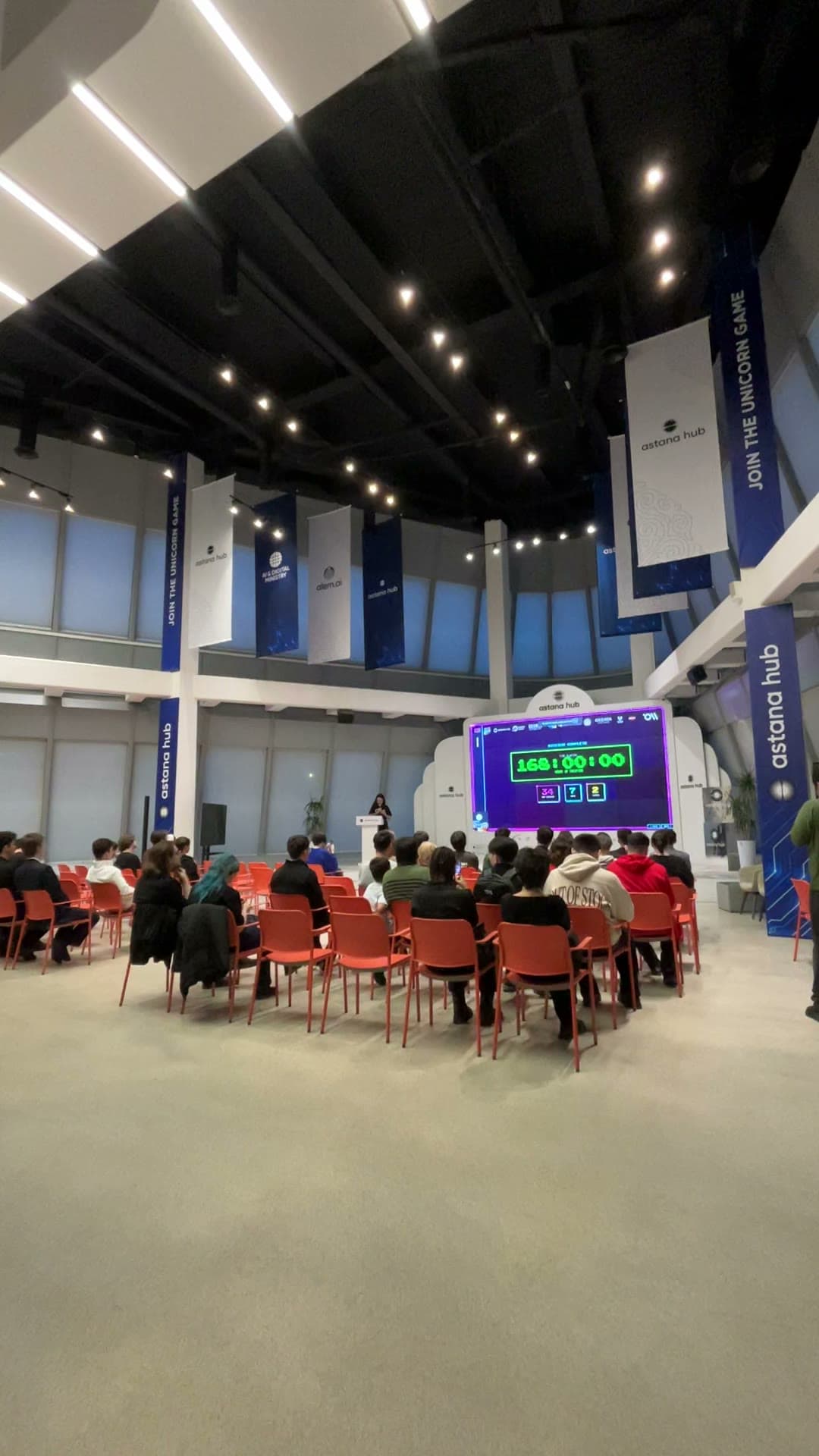
Solo or as a team
— from Kazakhstan and Central Asia, free to join
- 1–4
- people per team
- 2 of 4
- production layers with AI
- 10
- games reach the final
- 14+
- age; under 18 with a parent's consent
The Creata disclosure standard
Where AI worked, in plain words
Disclosure by layer is a submission rule. The format goes further than Steam and itch.io require, and it's free to use in your own games and jams.
The full standard on the GenAI page- Code
- Which parts were written with an AI assistant, what a human reviewed and rewrote
- Art
- Which assets were generated, with which tool, what was finished by hand
- Audio
- Music, sound, voice: the tool and the share that was generated
- Video and narrative
- Trailers, cutscenes, texts and dialogue — what was generated, what was written
- Rights
- Every tool's terms allow commercial use; no third-party intellectual property is present
- Human in the loop
- Who answers for the result and what exactly they checked before release
Jury
Who judges the games
Producers
«For us the jam is R&D: we want to see what you can already build with today's models, because the technology moves very fast. Jam builds used to be seen only by other game developers. We run this jam to meet the people behind them and invite them to join us.»
 David TuganovCo-founder of Creata Games · President of CIAQ
«We are building a Kazakhstani publisher to release games and support developers from Kazakhstan and Central Asia, and an Academy that trains people to work with artificial intelligence.»
 Hicham NouhouCo-founder of Creata Games · former senior executive at Tencent Games and Nintendo
Jury
Jury
Six practitioners from game studios and publishing: Lipsar Studio, Creata Games, Cyber Temple, Mytona, WorldChess. The jury plays the top 15 games by hand and scores them on the weights set out in the rules, published in advance.
After the jam
After the final on 3 October, Creata Games selects the top 20 projects for a two-month acceleration, online and offline. Teams get access to mentors and experts, learning events and a publisher's review of their game. Creata Games considers the most promising projects for further production. The rights stay with the team.
Where to submit and talk
Talk happens in the jam's Telegram group: announcements, mentor answers, finding a team. Work is submitted through a Google Form: the play link, a .zip archive of the game, gameplay footage, a PDF deck, the layer-by-layer AI disclosure and the repository if you have one. The deck template is in the materials below.
Submit your game ↗Game showcase
After the final, every submitted game will appear here — with gameplay footage, the AI disclosure sheet and a play link. Finalists first.
For inspiration
For inspiration
Games made with generative AI
A Game About Capybaras Delivering Food
@leocooout · Vibe Jam 2026, 1st place
A capybara courier delivers orders around Rio: take the order in an app, shop at a mini-market, ride by the in-game phone's navigator. Co-op included. Music and icons, the author says, were made with AI.
Fanto's Mega-Mart
@e_c_t_o · Vibe Jam 2026, 2nd place
Speed-shopping in a procedurally generated supermarket: time trials, ghost races, multiplayer. The author says he didn't know Three.js before the jam.
HALDANE-4
@denisbondare · Vibe Jam 2026, Most Original
An ASCII submarine-descent horror: a 10–15 minute run, procedural levels and sound, under 5 MB. The author calls it “99% vibe-coded”; the voice-over is AI.
Hollowlands
@andreeliasdev · Vibe Jam 2026
A multiplayer browser survival game: exploring, crafting, building and fighting in a procedural world. The author says he didn't hand-write a single line of code in 30 days.
unFamiliar
@GapingDrag0n · AI Browser Game Jam 3
A small surveillance horror. The game page states code, sound and voice were made with AI and the 3D is built in code — AI covers three of the four layers.
Cook the Dungeon
@DannyLimanseta · from jam to Steam
A roguelike deckbuilder: defeated monsters become ingredients for dish cards. The demo runs in a browser and the game already has a Steam page — a path from jam prototypes to release.
What's happening in the industry
- Runway released GWM Worlds 2 — a real-time interactive world with generated soundrunway.com ↗
- Gamescom: 13 of the 55 games at Opening Night Live used AI in development or marketingTheGamer ↗
- Playable multiplayer world models: MIRA and LingBot-World 2.0GitHub · MIRA ↗
- Meta launched Pocket — mini-games from a text promptTechCrunch ↗
- Game Oracle: Steam games that disclose AI get 53% fewer reviews in the first month — plan how you disclosePC Gamer ↗
- Cursor Vibe Jam 2026 results: 945 browser games, $25k for first placelevels.io ↗
FAQ
FAQ
What happens after the final?
Creata Games selects the top 20 projects for a two-month acceleration, online and offline: mentors and experts, learning events, a publisher's review of the game. The most promising projects are considered for further production; the rights stay with the team.
Can I take part solo?
Yes. A team is 1 to 4 people. You can find teammates in the jam's Telegram group.
Do I need to know how to code?
Not necessarily: AI assistants cover part of the code. What matters is that the game runs in a browser with no install. A repository is welcome but optional: without one, the source goes into the game archive.
Can AI write all of the code?
Yes. AI is required in at least two of four layers, and code can be one of them. What matters is disclosing honestly what was made and with which tool.
Which engines are allowed?
Any, as long as the game opens in a browser with no install: Three.js, Phaser, Godot or Unity with a web build, and others. For the play link, publish the game on GitHub Pages, itch.io or Vercel, and upload an archive of the same build to the form.
Who owns the game?
The team. We show games in jam announcements and results, credited to the authors; publishing happens only under a separate agreement with the team.
I'm 14–17. Can I join?
Yes, with written consent of a parent or legal guardian.
How much does it cost?
Participation is free.
How and by when do we submit?
Through a Google Form: the captain submits one response per team and can edit it until the deadline. Uploading the video, the deck and the game archive requires signing in to a Google account; the deck is a PDF of up to 7 slides, and each team has 3 minutes at the pitch plus 2 minutes of jury questions. The form closes on 1 October at 10:00 Astana time — the response timestamp counts, and late entries are not accepted.
Registration closed
The event has passed or the intake is over.